

⏱️ This edition of the West Vic Brolga newsletter is a five-minute read.
👋🏻 Good morning Brolga readers, happy Friday! Darcie with you for a dose of local news before we hit the weekend 😎 .
This week, I wrote about a new data centre proposed in Miners Rest. It’s attracting the ire of community members and local MPs.
I also spoke to Southern Grampians Shire Council and Hamilton Livestock Exchange about the new local processing system for organic waste and livestock effluent - and what it’ll mean for emissions 🐑 .
Zara broke down a promise from the Victorian Coalition to increase the speed limit on a major West Vic highway.
📣 Just quickly: Do you remember the Blockbuster in Ballarat? Or any other VHS and DVD rental stores? We’d love to read your memories about the type of movies you hired, the side treats you’d load up on and whether the late fees almost sent you broke.
On West Vic roads 🛣
Victoria has five major stretches of road with a 110-kilometre-per-hour speed limit and the state Coalition wants to bring that number to six. But West Vic Labor candidate for Polwarth Hutch Hussein has questioned whether the decision comes from research.
What happened: The Victorian Liberals and National parties have this week pledged to increase the speed limit on the Princes Highway between Colac and Laverton to 110 kilometres per hour.
Opposition leader Jess Wilson said in a statement the commitment would bring the proposed section of the road up to speed with “other comparable freeways” such as the Hume, Calder and Western freeways.
🗣️“People travelling on the Princes shouldn't be stuck in the slow lane, and under a Liberal and Nationals Government, they won't be,” she said.
Wilson said lower limits would still be in place through towns such as Winchelsea.
The background: The Princes Highway was duplicated from Colac to Geelong between 2016 and 2019.
The announcement follows a Coalition pledge to allocate $5 billion to “fixing one million potholes” statewide.
Questions for Coalition: Labor candidate for Polwarth, Hutch Hussein, argued decisions on speed limits “should be ones driven by evidence as well as community feedback”.
🗣️ “The Department of Transport continuously monitors speed limits across the road network, and there's a rigorous review process, and those decisions are made on a-case-by-case basis,” she told the Brolga.
“I think the Coalition needs to explain whether it’s about votes and neglect of safety, or just something that's kind of popular.”
Hussein said Labor has committed almost $3 billion in road maintenance since 2024.
🗣️“If the Coalition’s promising $40 billion in cuts, then road upgrades are going to be part of that as well. We’ve got to keep roads safe in proportion to their ability to hold cars running at that speed limit as well.”
How are speed limits set? Transport Victoria notes speed limits are set based on elements such as road environment, crash risk history, and how the road is used.
Areas with 110km/h limits are designed with additional infrastructure and safety measures in place.


From the Grampians and the Central Highlands ⛰
Southern Grampians Shire Council will cut 100 truck trips a year by processing livestock waste locally for the first time, keeping thousands of tonnes of effluent from the Hamilton saleyards in the region instead of transporting it more than 100km away.
How much exactly? Chris Dahlenburg, who has worked at the Hamilton Livestock Exchange for 38 years, said with a laugh he’s “never really measured it”.
🗣️: “It just piles up during the year, and we let it dry out over the summer,” he told the Brolga.
❓What happened: From spring of this year, Southern Grampians Shire Council will collect thousands of tonnes of livestock effluent, and green waste from household bins, to be processed at the Hamilton Transfer Station. Six new In-Vessel Rapid Composting systems, built off-site in Ballarat, will be used to create compost and soil products from the waste.
The council told the Brolga the move to local processing would help reduce emissions.
Council expects to use the by-products created from the waste as a new stream of revenue, to be resold as compost, “after a period of testing to deem the product safe”.
Why does it matter? A reduction in trips is positive for more than just the local shire.
The Truck Industry Council says that in Australia trucks account for four percent of national greenhouse gas emissions. The federal government puts this figure at 11 percent, and that’s only for rigid trucks, where the cabin and cargo area are attached to one chassis.
While Australia’s transport sector has been the largest source of growing emissions since the 1990s, recent federal government emissions data suggests they may have peaked.
The new plant will process over 5,000 tonnes of food waste annually. The council told the Brolga between 2,000 - 3,000 of this will be livestock by-products.
👥 What people said: Dahlenburg said that before trucks transported the waste, locals had been able to help themselves.
🗣️: “A few farmers took a bit, a few local people came and got a few trailer loads, and they just worked with it,” he said, adding that farmers would previously compost the waste for up to 12 months before using it on their paddocks.
As for the new approach, Dahlenburg said: “I can’t see why it won’t work.”

A new data centre could be built in Miners Rest, 10km from Ballarat.
❓What happened: Resi Ventures and X2M are developing new energy precincts in regional Australia. The Miners Rest Renewable Energy Integration Precinct will be the first project to go ahead, pending planning permissions.
🏗️ What will it look like: The data centre will be approximately 100 square metres, built on an old quarry site. The precinct will also provide battery storage, charging for heavy electric vehicles and an “anaerobic biodigester” to break down waste materials into biogas.
🌏The bigger picture: There are about 300 data centres in Australia.
Johanna Lim from the United States Studies Centre told our sister publication the Gippsland Monitor data centres will become “the backbone of the digital economy”.
“They underpin our digital lives. They allow us to access the cloud, internet, banking apps, healthcare systems, transportation and use AI tools like Chat GPT and Gemini.”
More talk: Labor MP for Ripon, Martha Haylett, said: “Miners Rest families deserve to be consulted before decisions are made that could fundamentally change their local area”.
City of Ballarat said while council staff “have had early conversations with the developer, no formal applications have been lodged”. It said key considerations included traffic, noise and environmental impacts and the views of the community.
The City also cited recent changes to legislation in Victoria that could see the Minister for Planning decide whether the project goes ahead.
What people said: MacKenna Keating from Ballarat was among the locals who expressed concern about the project to the Brolga.
“I’m not keen,” she said. “I’m worried about power and water usage, as well as wastewater disposal and noise pollution.”


On Your Feed 📱
🍃 Zara unpacked Glenelg Shire’s increased role in the renewable roll-out in Victoria:

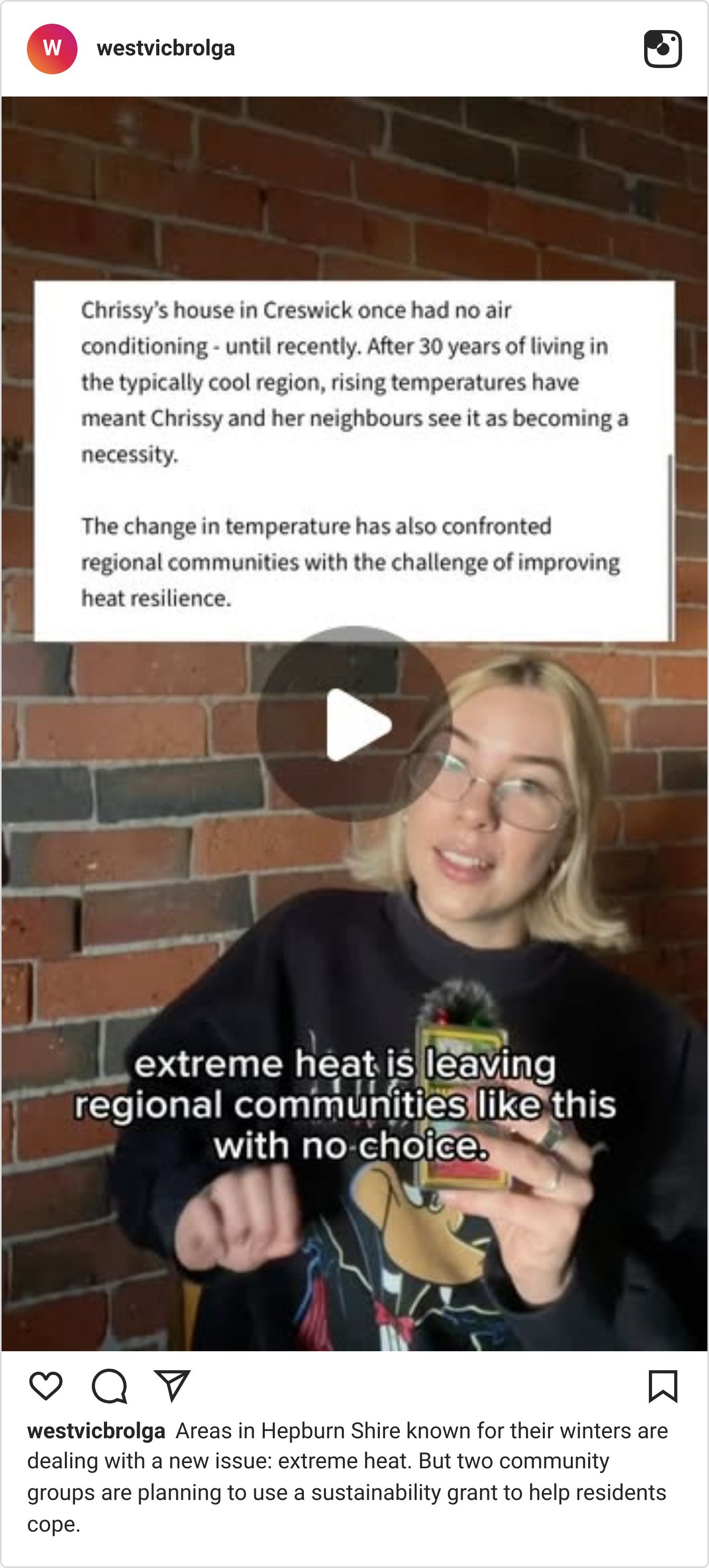
☀ And although it’s cold outside, I chatted to some locals in Hepburn Shire about a new grant and how they plan to use it to prepare the community for extreme heat events:

📰 That’s a wrap on the news and the week folks!
As always, please get in touch with any thoughts, comments, feedback or news tips you have for us. Just reply to this email 💌 .
If you want to stay up to date between editions, you can follow us on TikTok, Instagram and Facebook.
Cheers,
Darcie
How did you like today’s newsletter?
