
⏱️ This edition of the West Vic Brolga newsletter is a five-minute read.
👋🏻 Hey Brolga readers, Darcie with you today! Let’s dive into the Wednesday edition of West Vic happenings 👀.
I spoke with Naomi Lettieri, general manager of Colac’s Anam Cara House, which offers hands-on, homelike end-of-life care for locals. It is funded almost entirely by the community, and is currently running an appeal to keep the services going.
Zara took a look at plans in Hamilton to change the CBD so fewer heavy freight trucks are passing through, thus creating more space for public transport and local traffic. Plus, she learned about a new Landcare course to help farmers prepare for El Niño, which was declared by the Bureau of Meteorology yesterday.
Today, we’re seeking support from the readers who keep us hunting stories and collecting news each week. Any donation, big or small, makes a difference in keeping local journalism in our patch ticking.

Click this banner to donate!
A quick question: In light of the recent events at Poverty Point, we’re investigating the housing network around Ballarat to see how well it caters for rough sleepers.
What happens when people are told to pack up and move on? Where do they go, and for how long is emergency accommodation available? We want to talk to locals who are sleeping rough, or who have experienced homelessness in the past, about their experiences. You can remain anonymous.
Shout out at [email protected].
From the South-West 🗞️
☘ As El Niño becomes official, a West Vic Landcare course is teaching farmers to prepare soil for drier conditions
South-west Victorian farmers can sign up for a $5,000 resilient farming course for $300, with 10 heavily subsidised places available through the Heytesbury District Landcare Network.
What course? The Resilient Farming Course will help producers build practical skills in areas including soil health, grazing management, nutrient use and water management.
Landcare projects are often funded through government grants or private donations. The Resilient Farming Course is subsidised through funding from the federal government.
Each participating farm will receive soil, microbiology and plant tissue testing to better understand the health of their farming system.
Looming El Niño conditions: The program comes as farmers grapple with increasingly variable seasonal conditions. The Bureau of Meteorology officially declared an El Niño event last night, which typically means less rain for Victoria.
Heytesbury District Landcare Network vice-president Chris Hibburt told the Brolga water was “a really challenging commodity now for many of us who don't have access to underground water”.
“We have to work out how we manage to make the most of the water that does land in a very unreliable rainfall that's becoming less reliable as climate change seems to bite in,” he added.
What’s involved? Running between August and November, the course combines expert-led workshops with on-farm learning and will guide participants as they develop a tailored farm action plan.
The course is being delivered by the Heytesbury District, Central Otway, Upper Barwon and Warrnambool Coastcare Landcare networks, with 10 places available in each region.
Farming for the future: Hibburt said there was growing interest in how farming businesses could improve environmental outcomes while maintaining productivity.
"There's certainly a lot of questions being asked now about how our farming community can contribute in a positive way, both for themselves and for the environment," he said.
Applications close on June 30. Farmers interested in joining the course can contact Landcare Facilitator Debbie Dalziel at [email protected].

🚚 Southern Grampians pushes “expensive” plan to re-route trucks and improve bus services in Hamilton
Getting heavy vehicles out of Hamilton’s CBD is still a long-term goal, but Southern Grampians councillors have been warned creating an alternative route for trucks would be an “expensive exercise”.
What happened: At last Tuesday’s Southern Grampians Shire Council meeting, councillors signed off on the Hamilton Moves Transport Plan, which sets out future improvements for roads, footpaths, cycling, public transport and heavy vehicles.
One of the biggest ambitions is to eventually move heavy vehicles away from the CBD as council presses on with major upgrades to the town’s central streetscape and new community hub.
How heavy? Heavy vehicles passing through Hamilton’s CBD are mainly large freight trucks such as semi-trailers, which use the town as part of broader statewide freight routes.
While the town’s northern alternative heavy vehicle route was partly modified last year to remove non-local heavy traffic, the southern route and Cox Street corridor continue to carry trucks through and around the CBD.
Easier said than done: Infrastructure and sustainability director Marg Scanlan said a diverted road for trucks would not be straightforward, likely requiring significant funding contributions from the state or federal government.
Pushing for more buses: Public transport remains a major challenge for the town. Councillor Helen Henry said Hamilton was still among the state's poorest-served regional centres for public transport.
🗣️“That has an incredible impact on people who are trying to access medical care or further education,” she said.
🗣️“It baffles me that we cannot get our young people down to our university and our two TAFEs that are only an hour and a bit away for them to access educational opportunities, so I think there's still a lot of work to be done.”
The background: The transport plan grew out of community consultation that began in 2022 and has already delivered a range of projects, including heavy vehicle route changes, road safety improvements, footpath upgrades and electric vehicle charging infrastructure.
Councillor Jayne Manning said more than 5km of footpaths had been delivered through the town’s missing links program, along with reduced speed limits, raised crossings for trains and safety improvements around Lake Hamilton.


From Colac-Otway 🗞️
Palliative care doesn’t just mean the last few days of life. For Anam Cara House, in Colac, it can be a relationship built in stages across a decade.
Now, the hospice is in need of fundraising to continue its work.
What's that? Anam Cara House is a community-owned hospice that provides palliative, respite and end-of-life care for people in south-west Victoria.
“It’s a lovely mix of accessible care when people need it the most,” General Manager Naomi Lettieri told the Brolga. “It’s quite homelike, quite unique in its nature.”
The hospice is run out of a five-bedroom house originally constructed by a local builder to house himself and his seven children. Each bedroom has a large door leading outside. The name - Anam Cara - is the Gaelic phrase for “soul friend”.
Getting started: Anam Cara Colac opened in 2012, after the local hospital underwent renovation.
🗣️: “The hospital [in Colac] had been redeveloped and the palliative beds went into the acute ward,” Lettieri said. “It [starting Anam Cara] was a massive community initiative, one of the largest in the region at the time.”
The facility is based on the Geelong Anam Cara House design. Diane Wright, the founder of this facility, joined efforts to set up the Colac edition.
Why is it so important? Lettieri said palliative care involves a huge array of supporting measures for chronic illnesses and the psychological, financial and emotional implications.
🗣️: “Palliative care in its truest form is a model of care that spans many years, from the point of diagnosis for some folk.”
“The relationship can span for many years. We become an extension of someone’s family. They get to know us and it’s really person-centred, really family-centred.”
This level of care isn’t always available in a clinical environment, allowing space for a more welcoming and comfortable space for guests.
🗣️: “We can do things that may not be achievable in a hospital environment at Anam Cara. For obvious reasons, there are tasks [in a hospital] that need to be done in certain ways and certain times. At Anam Cara, it’s more of what they want and when.”
“We've had everything from a christening to a bride and groom turning up [to visit a guest], a smoke ceremony. We even had a car club visit one of their members. It’s an array of things that are bespoke to that person and their needs.”
How you can help: Non-recurrent government funds account for 15 percent of operational costs, alongside several home-care packages and NDIS programs.
Mostly, the facility is funded through philanthropy and donations from the community. There is a current community appeal open from now until the end of the financial year,
“We’re not bound by geography. A lot of people leave, and then come home to die in Colac.”
In 2025, the Anam Cara facilitated 1,610 care experiences for south-west Vic residents. To donate, you can head here.
🗣️: “As nurses, we want to help people and make a difference and enrich their lives in a way that's really respectful.”


On Your Feed 📱
Zara and I have been very busy recently hopping in front of the camera to break down our stories 🎦
As part of our fundraising appeal, I sat down to talk about my first few months at the Brolga and how much I’ve enjoyed learning about my patch in a changing world:

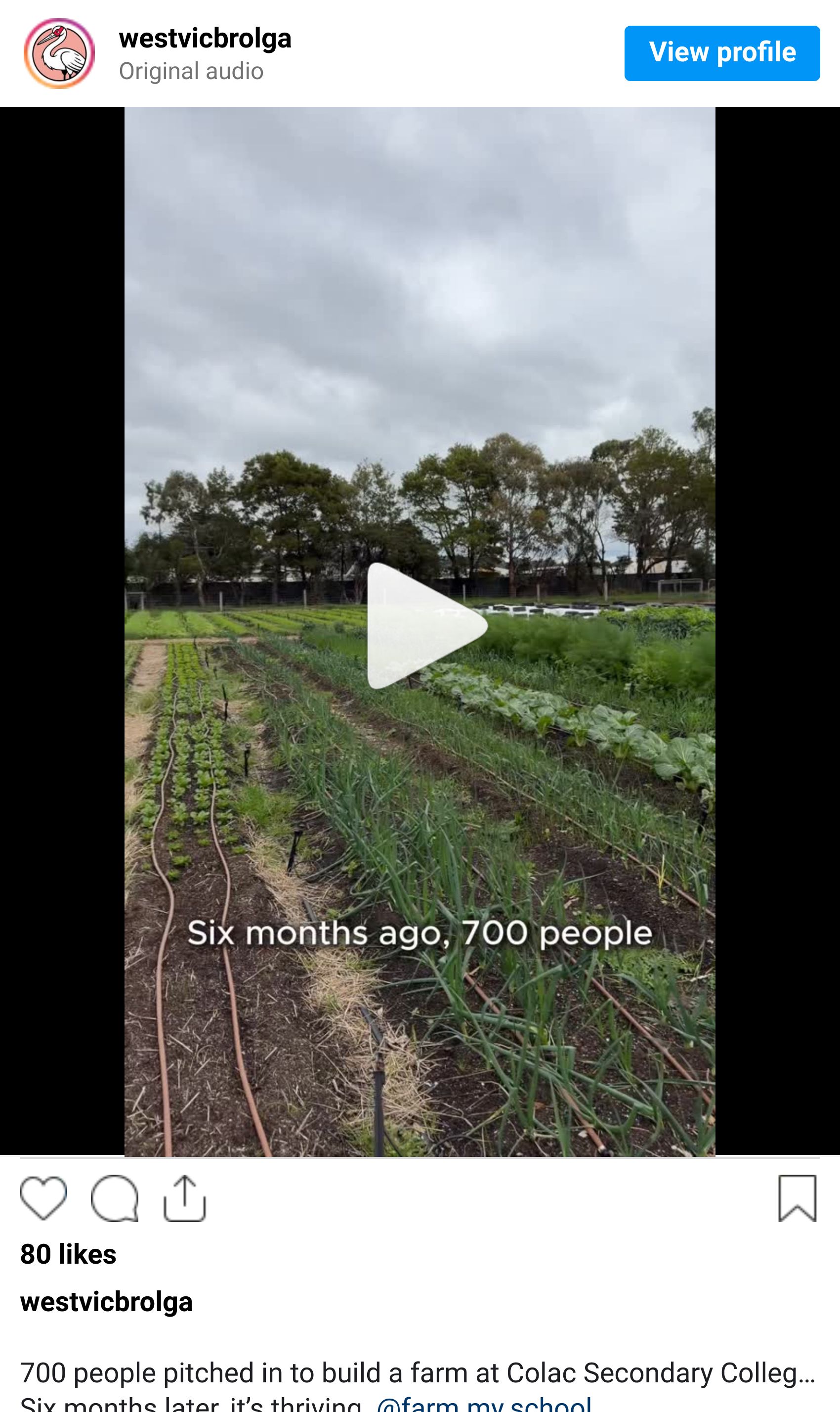
Zara visited a farm that was built overnight at Colac Secondary School:
And I unpacked what El Niño might mean for Ballarat farmers, which was declared yesterday evening:



Click this banner to donate!
That’s a wrap on today’s newsletter! As always, please get in touch with any thoughts, comments, feedback or news tips you have for us. Just reply to this email 💌 .
If you want to keep up with what’s going on around West Vic, you can also follow us on TikTok, Instagram and Facebook.
Catch you next week folks,
Darcie