
⏱️ This edition of the West Vic Brolga newsletter is a five-minute read.
👋🏻 Hello Brolga readers, welcome back to another Friday newsletter with Zara.
Darcie has been unwell, so I’ll be taking you through my latest stories:
An article on the large-scale Warracknabeal Energy Park wind farm moving a step closer to fruition,
Another story on the launch of Warrnambool Coastcare Landcare Network’s latest biodiversity farming program,
And a list of 10 breweries to visit across West Vic.
Get well soon, Darcie!
Let’s jump in.
Zara’s latest stories 🗞️
Thirty-five farmers in Victoria’s west are a step closer to hosting the largest wind farm in the Southern Hemisphere after the state planning minister signed off on the Environmental Effects Statement (EES) for the 219-turbine project.
A big investment: The Warracknabeal Energy Park would deliver more than 1.5 gigawatts of renewable energy annually - enough to power up to 1.2 million homes and supply 12.5 percent of Victoria’s future energy needs.
Planning minister Sonia Kilkenny said in a statement last week the project could create almost 950 jobs during construction, alongside ongoing operational roles once complete.
Environmental process: The process for renewable energy developments completing an EES statement includes technical studies, community consultation and a public inquiry.
“This rigorous EES process has shown this project can go ahead while meeting Victoria’s environmental standards,” Kilkenny said.
Opinion vs fact: The project’s milestone coincided with unchecked claims published in mainstream media about government subsidies for the ways large-scale renewable energy projects are funded.
In coverage by ABC News, Wimmera Mallee Environmental and Agricultural Protection Association president Ross Johns claimed wind farms required between $850,000 and $1 million per turbine each year in government support to remain viable.
Applied to the Warracknabeal project, that figure would amount to between roughly $186 million and $219 million annually.
WestWind responds: WestWind energy, the company behind the development, rejected the figures outright, saying they did not reflect how Australia’s energy market operates.
“The claim that wind farms require ‘$850,000 to $1,000,000 per turbine per year of government support to operate and function’ is incorrect and not supported by how Australia’s energy market operates,” it said in a statement to the Brolga.
No subsidies here: WestWind said it did not receive government subsidies to operate wind farms and said there were “no mechanisms in Australia that provide ongoing per-turbine payments of the kind described”.
“Wind farms generate revenue by selling electricity into the National Electricity Market, just like any other generator,” the statement said.
Real motive: While renewable energy projects can access schemes like renewable energy certificates, WestWind said these were designed to encourage investment in new energy generation, rather than provide ongoing taxpayer funding to keep wind farms running day to day.
The company also pointed to the CSIRO’s GenCost analysis, which has consistently identified onshore wind and solar as Australia’s lowest-cost forms of new electricity generation since 2018 - which “would not be the case if projects required large ongoing subsidies to operate”.
The development still needs Commonwealth approval under the national environmental laws before a final decision is made.

A Warrnambool landscape restoration project is aiming to plant one million trees and restore 400 hectares of land by 2040 in a response to declining biodiversity in the region following extreme weather like drought and grassfires.
What is it? The new program, LandLife SouthWest, comes after two years of pilot projects that organisers say revealed local farmers had strong interest in improving their soil health, drought resilience and native vegetation on their properties.
The Warrnambool Coastcare Landcare Network (WCLN) will lead the initiative, focused on encouraging and practicing regenerative farming through community tree planting days and workshops.
Harsh conditions: WCLN senior landcare facilitator Geoff Rollinson said south west Victoria’s agricultural industry was increasingly under strain from hotter and dried conditions.
“These shifts are placing increasing pressure on townships, communities and agricultural landscapes that have already been heavily modified by decades of intensive farming,” said Rollinson.
“It will open opportunities to connect fragmented native vegetation areas and create wildlife corridors, increase biodiversity and native vegetation, improve soil and water quality and animal health and bring life back to the land”.
Better for business: The Brolga previously spoke to Panmure beef farmer Stephen Warth, who participated in the pilot program to find solutions for his farm after experiencing major impacts from last year’s drought.
About half of Warth’s 60-acre property “barely grew a blade of grass for a while”, he told the Brolga in September.
Warth said the program has highlighted the importance of improving soil and plant health in running a sustainable farming business.
A long-term vision: WCLN chairman Bruce Campbell said the initiative was a long-term investment in both environmental restoration and agriculture.
“It’s not a three-year plan, it’s a 30-year plan to build a truly sustainable agriculture industry in our region,” Campbell said.
The program has received funding from the Fletcher Jones Family, Gall Family, the Brodie foundation, and the Gwen and Edna Jones foundation.
Hotter conditions in the years to come: Climate modelling shows southwest Victoria is likely to experience hotter, drier conditions in coming decades, with more frequent droughts.
The Victorian government’s Climate Science Report 2024 warns the state faces increasing heatwaves, droughts and bushfires, driven by rising temperatures, declining winter rainfall and drier soils.

Western Victoria’s brewery scene stretches from the Great Ocean Road to the Grampians - the Brolga has collated a list of ten around the patch to indulge in.
Aunty Jack’s Brewery
Ballarat’s Aunty Jack’s Brewery combines a working brewery with a lively pub atmosphere in the city centre.
The brewery produces a broad range of approachable craft beers, including pale ales, lagers, stouts and rotating seasonal releases.
Where: 315-317 Mair Street, Ballarat Central
Opening hours: Mon-Thurs: 4pm-late, Fri-Sat: 12pm-late, Sun: 12-9pm
More info
Forrest Brewing Company
Set in the Otways, Forrest Brewing Company is known for small-batch beers brewed with mountain water sourced locally. Alongside IPAs, pale ales and dark beers, its strawberry beer has become a popular option for visitors who are not traditional beer drinkers.
Where: 26 Grant Street, Forrest
Opening hours: Sun-Mon: 9am-5pm Fri-Sat: 9am-9pm
More info
Noodledoof Brewery and Distillery
Noodledoof Brewery and Distillery operates out of a former milk factory near Koroit, producing craft beer and small-batch spirits with a focus on local ingredients. Expect hazy ales, lagers and experimental seasonal brews alongside gin and whisky.
Where: 128 Commercial Road, Koroit
Opening hours: Mon-Thurs: 10am-5pm Fri: 10am-late Sat-Sun: 10am-5pm
More info
Great Ocean Road Brewhouse
Great Ocean Road Brewhouse offers one of the region’s largest beer selections, with more than 100 beers on offer including its own house-brewed range. The brewery focuses on easy-drinking coastal styles including pale ales, lagers and summer ales.
Where: 29-35 Great Ocean Road, Apollo Bay
Opening hours: Open daily from 11am
More info
Otway Estate
Part brewery, distillery and winery, Otway Estate produces craft beer on a rural property near Colac. Its range includes lagers, pale ales and darker malt-forward beers, alongside house-made spirits.
Where: 10 Hoveys Road, Barongarook West
Opening hours: Sat: 11am-5pm Sun: 11am-4pm
More info
Suffoir
Known primarily for wines, Suffoir also produces beers and mixed fermentation brews using locally grown ingredients. The venue leans toward smaller, experimental batches rather than traditional pub styles.
Where: 144 Mt Eccles Road, Macarthur
Opening hours: Friday-Sunday 11am-5pm
More info
Blackman’s Brewery
Surf Coast staple Blackman’s Brewery brews a wide range of beers, from crisp lagers to hop-heavy IPAs. The Torquay venue on Bell Street is also known for its large beer garden and regular live music.
Where: 26 Bell Street, Torquay
Opening hours: Wed-Sun: 12pm-late
More info
Bank House Brewery
Operating from a restored heritage building in Dean near Ballarat, Bank House Brewery produces small-batch beers with a focus on unusual flavours and seasonal experimentation. Its truffle beer has become one of its more talked-about brews.
Where: 1360 Ballarat-Daylesford Road, Dean
Opening hours: Typically open from 10am-4pm on a weekend, check social media pages for updates
More info
Paper Scissors Rock Brew Co
Paper Scissors Rock Brew Co is a laid back brewpub producing small-batch, modern craft beers in the centre of Halls Gap. The beer garden offers a relaxed backdrop with views of the Grampians.
Where: 119 Grampians Road, Halls Gap
Opening hours: 12-8pm daily
12 Apostles Brewery
Located on the same site as the Sow and Piglets Guesthouse, 12 Apostles Brewery brews a small range of beers inspired by the coast, including pale ales, lagers and amber ales aimed at travellers visiting the Great Ocean Road.
Where: 18 Tregea Street, Port Campbell
Opening hours: Hours vary


On Your Feed 📱
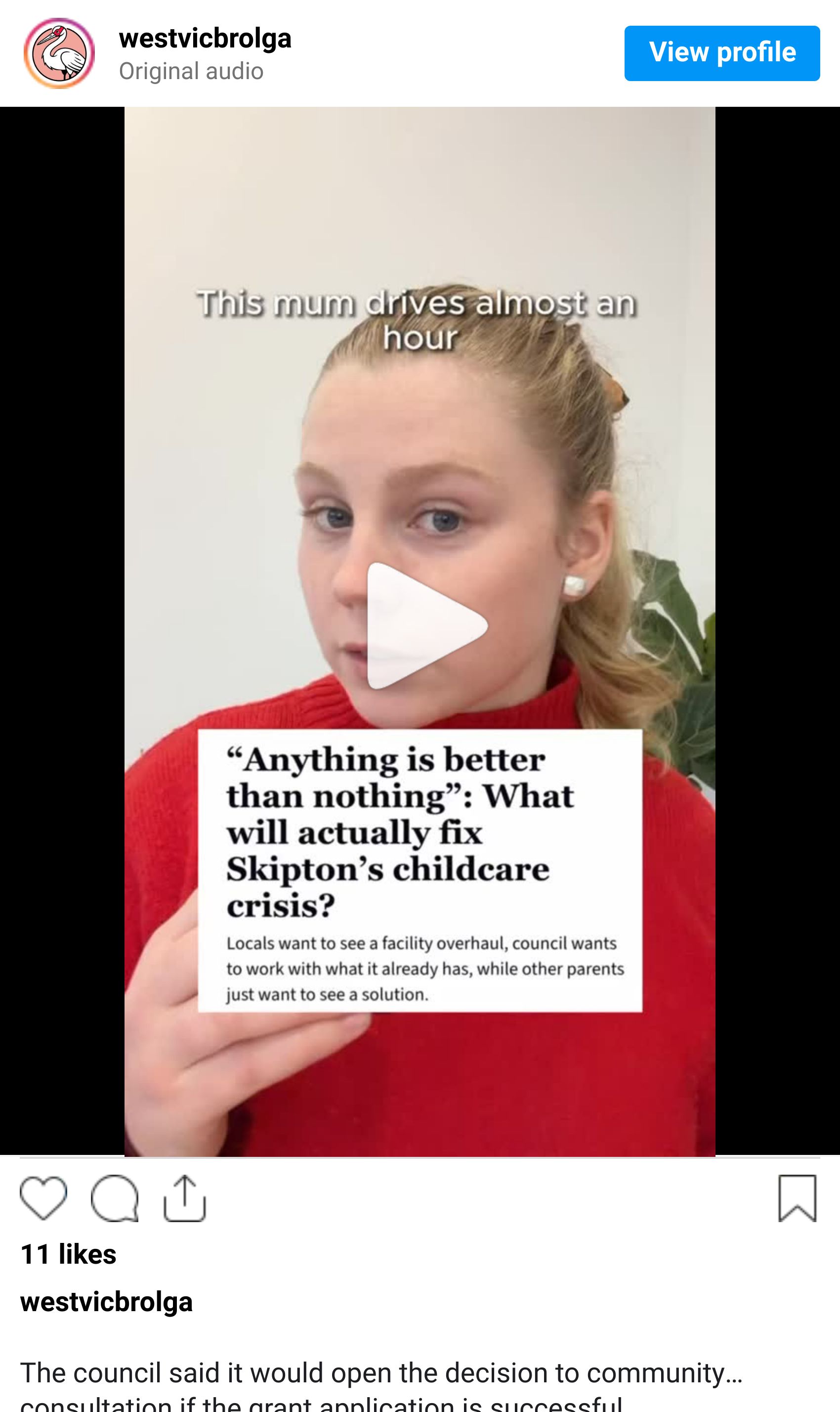
In case you missed it, I put together a video rundown on Skipton’s childcare crisis discussion. You can watch it below.

Thanks for reading today’s newsletter folks, hope you enjoy your weekend.
As always, please get in touch with any thoughts, comments, feedback or news tips you have for us. Just reply to this email.
If you want to stay up to date between editions, you can follow us on TikTok, Instagram and Facebook.
Cheers,
Zara