

⏱️ This edition of the West Vic Brolga newsletter is a five-minute read.
👋🏻 Hello Brolga readers, Zara here.
Darcie has enjoyed some well-earned time off this week, so I have another light read for you today. Here’s what’s coming up in this Friday edition:
🚲 A recent state government announcement for a new pump track at Koroit;
🔌 Experts break down the cost, time and efficiency of the Victorian Coalition’s gas plan;
🐑 And we take a look behind the scenes of the Patchewollock Music Festival.
The latest news in the south west 🗞️
A sought-after pump track and youth space in Koroit that “started at the grassroots” through local advocacy has landed enough state funding to begin the project.
What’s going on: The Victorian government has committed $450,000 to the Koroit Youth Space project, which joins a $400,000 contribution from council and more than $100,000 raised locally.
The project: The money will deliver a pump track, accessible footpaths, seats and shelter upgrades, plus a refurbished basketball court at the existing skate park.
Mayor Jordan Lockett said in a statement about 30 percent of Koroit’s population was aged 10 to 24.
“It's important we provide the kinds of spaces and activities young people want to use and can be proud of,” he said.
Now what? The council said it would continue to plan the works for the funded parts of the project while chasing funding for later stages of the youth space, including a playground and landscaping.

Victoria’s gas reserves are critically low and the Victorian Coalition, if elected, has put its money on offshore and onshore drilling to fix the problem, alongside connecting the state to thousands of kilometres of gas pipelines from the country’s north.
But experts say that could cost billions, take at least five years to build and would be unlikely to bring gas prices down.
What’s going on: Speaking to the Brolga at last Thursday’s Polwarth candidate forum, Liberal Polwarth MP Richard Riordan said the Coalition’s priority for energy was to tap into existing offshore gas infrastructure in the Otway Basin near the Twelve Apostles and Port Campbell to “bring gas cheaper and more quickly to market”.
“We hope that in the very near future we will have a gas industry that is reinvigorated and bringing gas to market,” he said.
State of play: Victoria gets the majority of its gas from offshore drilling in the Otway and Gippsland basins.
Currently, there is no requirement for gas found in Victoria’s reserves to stay in the state. Once it enters the gas grid, where it ends up depends on who purchases it.
Victorian gas often ends up in Queensland or gets exported overseas.
Riordan said the Coalition, if elected, would prioritise granting offshore and onshore exploration permits to source new gas supplies.
The search for gas: Offshore gas exploration is already taking place in the Otway Basin, but Kevin Morrison, an Australian oil and gas finance analyst at the Institute for Energy Economics and Financial Analysis (IEEFA), said four wells were drilled in the past year and two found nothing.
Grattan Institute Energy and Climate Change Director Alison Reeve told the Brolga offshore exploration was not a realistic fix to Victoria’s gas supply issues.
“If there were large amounts of cheap gas there, we would have already located them. Any new gas is likely to be more expensive than what we have now, because the cheap-to-extract gas is gone,” she said.
Getting gas to market takes time: Even if new gas was found, Reeve said it usually takes around a decade from exploration to first production for a new field, though expanding an existing one could be quicker. She agreed existing infrastructure near Port Campbell would help with processing, but explained that new wells and pipelines would still be needed.
Reeve said issuing more permits for exploration would be costless for the government, but the state would be better off making the most of the gas it has left and supporting households to switch to electricity to save costs and free up gas for manufacturers and electricity generators.
Can we get it elsewhere? When asked how the Coalition’s gas strategy would deliver given Victoria's critically low gas reserves, Riordan said work was underway for domestic pipelines stretching from Darwin and Northern Queensland which could help bring more gas to local markets.
What pipelines? There are a number of gas pipeline projects across Australia - large underground steel pipes carrying gas from where it’s produced to where it’s used.
Kevin Morrison, from IEEFA, said the pipeline infrastructure exists, but only at a small scale compared to what would be required to bring gas to Victoria.
The Northern Gas Pipeline, for example, which can carry gas from the Northern Territory to Victoria and other southern markets, has a capacity of 90 terajoules (TJ) a day - about a fifth of Victoria’s average daily demand, or enough for roughly 550,000 homes.
In other words, even running at full capacity, the existing link could only cover a fraction of what the state uses, so replacing Victoria’s gas supply would require building something far bigger.
How long? According to Morrison, pipeline operator APA Group has suggested any official decisions to invest in an expansion are at least two years away, followed by a three-year build time at minimum.
“[Gas companies] need to do a lot more exploration work in order to prove that it is commercially viable. So when people are talking about just bringing gas down from the Northern Territory, there's quite a few steps that have to be taken. It's not like it's all ready to go,” Morrison said.
How much? A large-scale expansion of the pipelines would likely cost “multiple billions of dollars”, Morrison predicted.
“That's just for for the pipeline itself, so you'd have to also add on top of that the cost for the development of the fields, which again, if they're to be developed to anywhere near the potential that some of the proponents are talking about, that would also be a very, very, very large sum.”
Despite new gas supply to Victoria, the expansion would be unlikely to reduce power bills, as developers look to recover the upfront costs of their investment.
“The economics of any sort of large gas infrastructure investment would rely on the export market because the domestic market isn't big enough to justify a massive investment in a new gas pipeline from the Northern Territory.”
No fracking: Riordan said the Coalition has ruled out fracking on Victorian farmland, as the Victorian Constitution prohibited it, and the party has “no desire” to pursue it.
The Coalition has not settled on a 2030 renewable energy target, citing uncertainty around transmission. The Victorian government says renewables supplied 45 percent of the state’s electricity in 2025, with a target of 65 percent by 2030.

On Your Feed 📱
Contributor Brittany Fontana recently visited the Patchewollock Music Festival. Check out the video below for her recap of the Patchewollock Gold Cup, the highlight of the day.

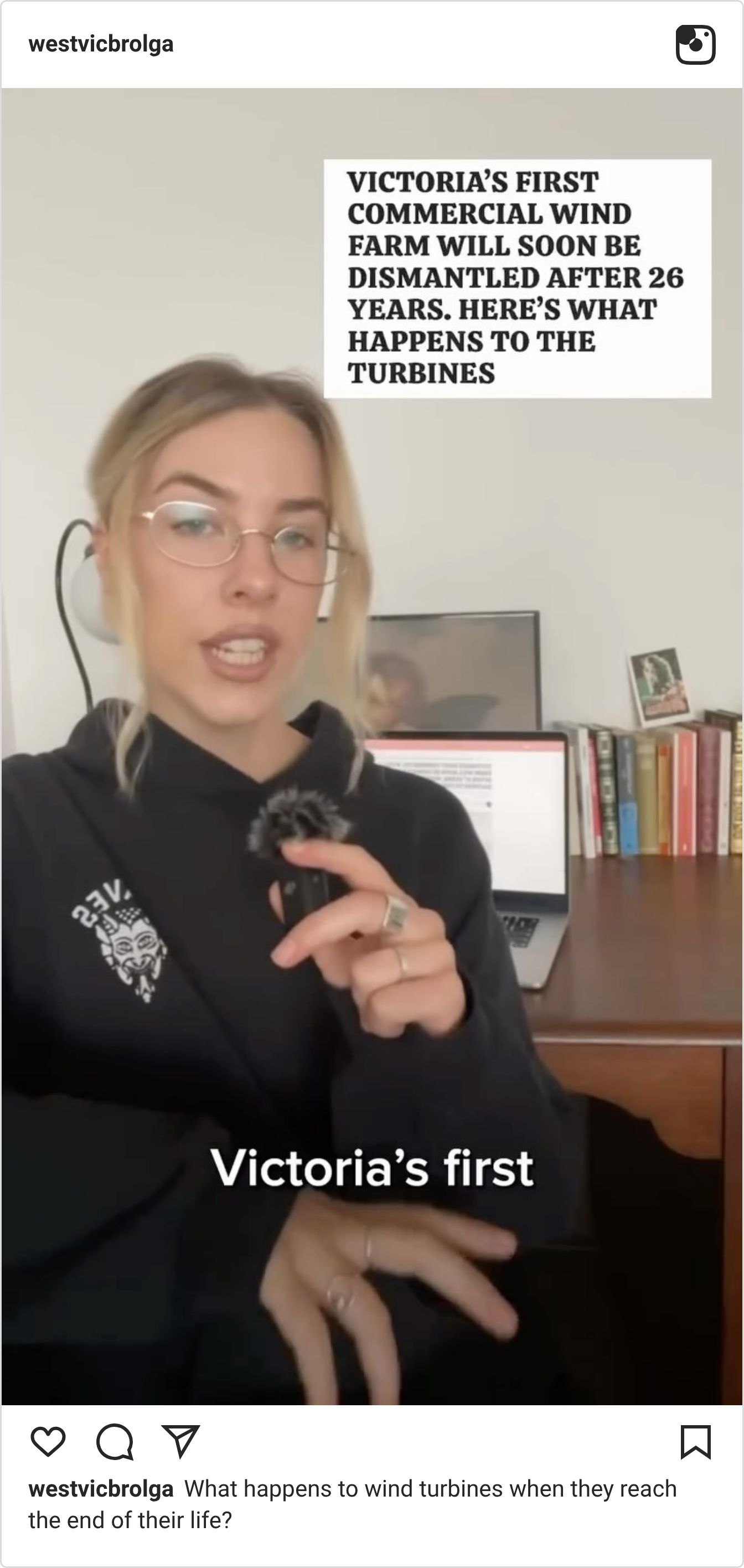
Darcie breaks down the options for wind turbines when they reach the end of life stage in the video below.

Thanks for reading today’s newsletter folks.
As always, please get in touch with any thoughts, comments, feedback or news tips you have for us. Just reply to this email.
If you want to stay up to date between editions, you can follow us on TikTok, Instagram and Facebook.
Cheers,
Zara