

⏱️ This edition of the West Vic Brolga newsletter is a five-minute read.
👋🏻 Once again, happy Wednesday Brolga readers! Darcie with you today 🤙
Zara is sadly unwell, but luckily left us with some wide-ranging yarns before sickness struck her down. Here’s our major headlines from the last few days:
🏫 The history of Camperdown’s name;
💡 The Victorian Coalition’s plan to scrap VNI West if elected in November;
💰 What that means for your power bill.
🏚 Facilities falling into disrepair in the Pyrenees, and councillor saying there’s no funding to fix them;
🚆 The potential reinstatement of a passenger line between Ballarat and Geelong;
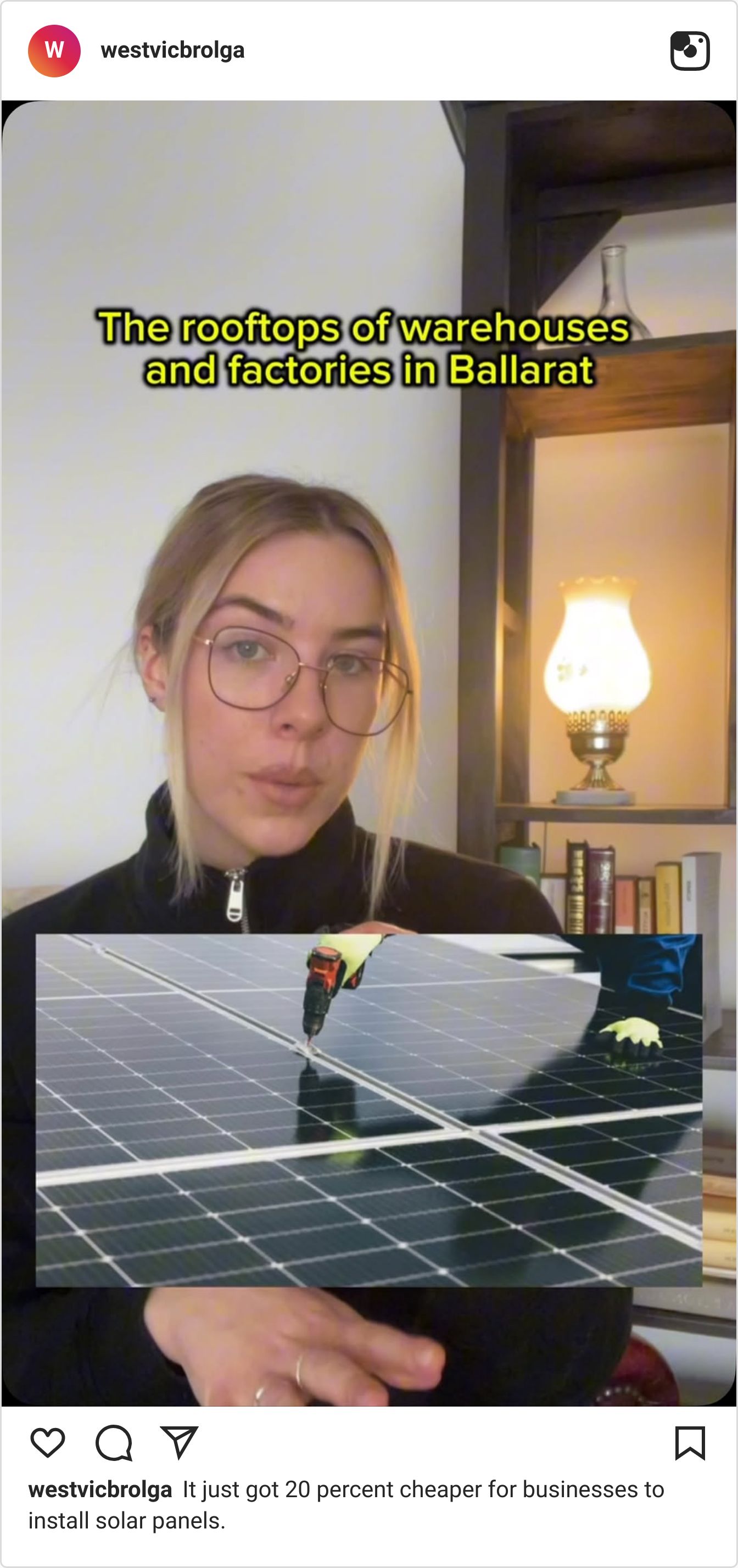
☀ Plus, whether a price cut from the federal government will bring more solar panels to the ‘Rat.
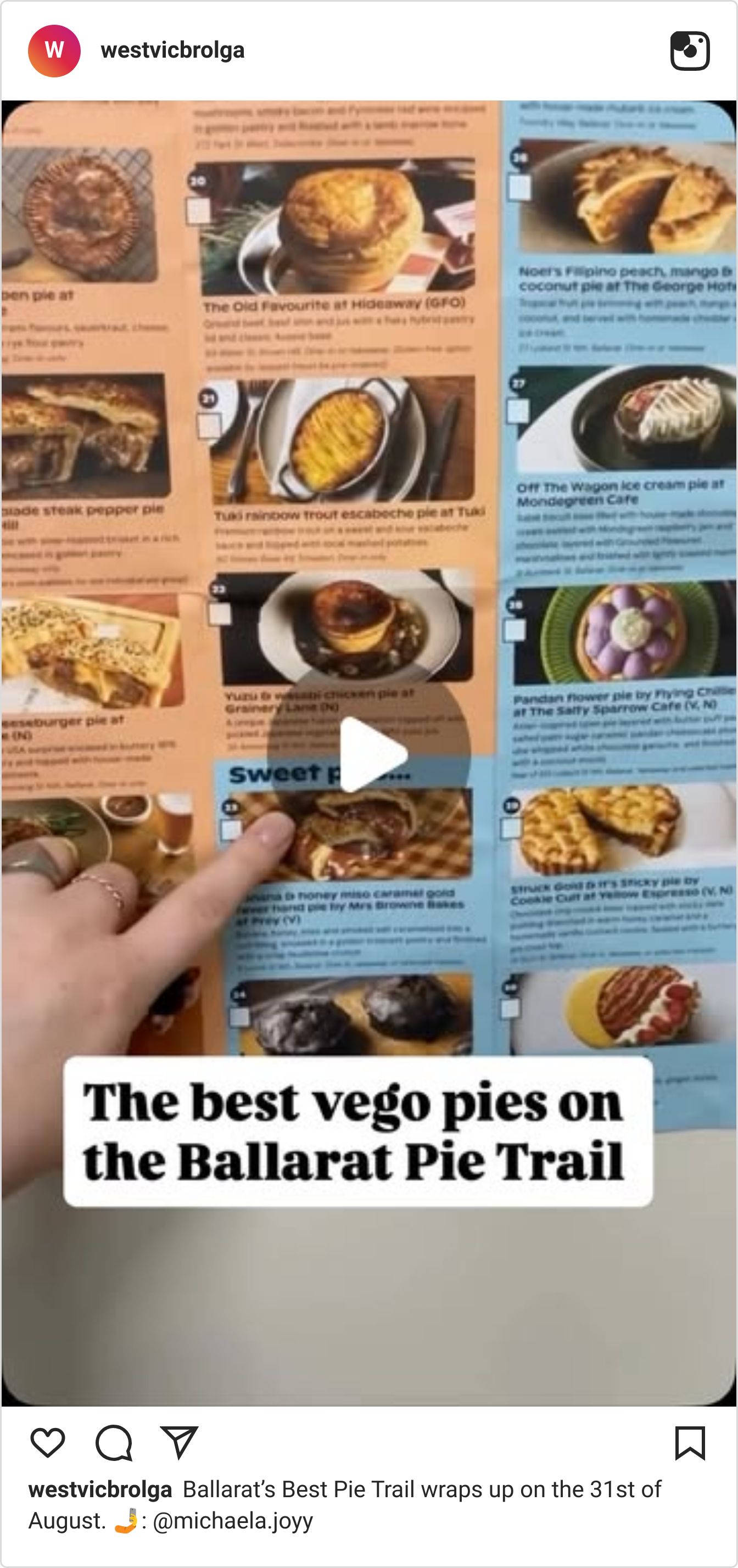
Quick hits: Ballarat local Michaela explored the best parts of the Ballarat Pie Trail for a vegetarian. Watch that video below 🥧
West Vic trivia 🌊
Where did Lake Wendouree get its name?

In the southwest 🗞️
The Victorian Coalition, if elected in November, will scrap the Victoria to NSW Interconnector West project (VNI West).
But the Coalition’s plan to replace the 240km high-voltage overhead electricity transmission lines with more gas doesn’t stack up, according to the Grattan Institute’s Alison Reeve. She argues the supply of gas doesn’t exist.
Only opposition? There are 220 landholders on the “preferred easement” (the route of the lines) for VNI West, but it is unknown how many of them oppose it.
The project has not reached the stage where consent is tested by the number of people willing to host lines on their properties. Vicgrid, which is overseeing the project’s planning and development, says one-third of the properties have granted access for surveys.
Craig McIntosh is a sixth-generation sheep, cattle and crop farmer at Tragowel, near Kerang in Victoria’s north-west. He became interested in hosting lines after an earlier proposed route had met with resistance from some of those impacted.
🗣️ “[VNI West] was [initially] going to go through a route through Tragowel, and me and a few neighbours said, ‘Well if they’re against it, we both think we should be doing it, why not bring it up through our farms?’” McIntosh told the Brolga. “And so we proposed another route for them to go through.”
Gas shortage: The Liberals and Nationals have said more permits for gas exploration would be made available to increase the state’s supply, but Grattan’s Alison Reeve questioned the logic behind this.
🗣️ “I don’t think there would be enough gas there for a significant new development to significantly change the supply for Victoria. You can explore all you like, but if the gas isn’t there, it’s not there. This is one of the things about a finite resource, and gas is a finite resource, is that once you’ve burned it up, it’s gone.”
Around 90 percent of Victoria's commercially-viable gas reserves have already been consumed, according to the Department of Climate Change, Energy, the Environment and Water’s 2025 Australian Energy Statistics and Geoscience Australia's 2025 Energy Commodity Resources.
Groups weigh in: Farmers for Climate Action has 1,900 farmer members in Victoria. The group conducted a survey with those members in early 2026, asking them the biggest pressures facing their day-to-day operations.
The farmers who responded listed dealing with natural disasters driven by climate change and water security as their main struggles - transmission was listed last.
Farmers Fightback have been running a national campaign strongly opposing the project.
Founder Ben Duxon told the Brolga the group was created in February for “exactly this”.
Shut it down: “One purpose. Stop VNI West … Six months later both the Coalition and One Nation have committed to scrapping the project. That is the campaign doing precisely what it was built to do. None of it was an accident,” Duxon said.

Zara explained how Camperdown was almost called Duncan, after a local settler’s mate, but ended up with a name tied to northern Holland.

In the Central Highlands 🗞️
👟 Pyrenees sporting facilties are “end of life” with no funding to fix them
Pyrenees councillors say they have no money to fix the region’s collapsing recreation facilities, as local bowling greens miss out on major tournaments and sporting pavilions crumble.
Roland Currie, at the Landsborough and District Bowling Club, said it’s “getting harder and harder these days to get any help regarding sporting venues”.
The impact is felt throughout the whole community.
“For us small towns, we’ve already lost the pub, and we’ve lost everything else in town,” Currie said. “It’s the last thing for men’s health, women’s health, everyone to gather and chat.”
“We’re losing major tournaments coming to town because you can’t bowl on the green. That brings money and people to town”.
What happened: While endorsing a routine update to its 10-year asset plan, councillors Simon Tol and Damian Ferrari, as well as Douglas Gowans, the Director of Assets and Development Services, openly conceded the shire cannot afford to renew ageing recreation facilities.

A direct train line between Ballarat and Geelong existed until 1978, and now locals and politicians are calling for reconnection.
The current state: Right now, the one-hour drive between Victoria's second and third largest cities takes 2.5 hours by public transport with multiple service changes, or requires catching one of three daily coaches.
Rail Future Institute (RFI) president and former V/Line Chief Operating Officer John Hearsch said a passenger train comeback could be possible with minor upgrades and an estimated $100 million price tag.
Who? RFI is an independent group formed to promote “sustainable rail solutions” for both public and freight transport.
Doing the math: A direct trainline along the route seems like an obvious connection; it reduces the amount of cars on the road, which is good for the planet, and reduces fuel usage, which is good for the pocket.
So why doesn’t it exist?
Looking back: Historically, it did.
A trainline was first constructed in 1862 as a major railway link during the rapidly expanding gold rush that swept Victoria in the mid-19th century
The train stopped at Bannockburn, Lethbridge, Meredith, Elaine, Lal Lal, and Ballarat.
Parts of the track deteriorated over time and passenger travel was discontinued in 1978. Today, it transports freight and, rarely, heritage steam trains.

I unpacked how an announcement from the federal government coul dmean more solar panels on top of Ballarat businesses.

Many thanks for joining us today, folks 🫶
As always, please get in touch with any thoughts, comments, feedback or news tips you have for us. Just reply to this email.
If you want to stay up to date between editions, you can follow us on TikTok, Instagram and Facebook.
Cheers,
Darcie