


Forwarded this newsletter? Sign up here for free.
Happy Wednesday Brolga readers! Darcie with you today. The Italian tyres on my Lexus GS300 couldn’t hack it on the Midland Highway, so I am now the proud owner of a RAV4, circa 2006. Good call? What do you think?
Now, the headlines:
🗞️ The news 🗞️
What we’re hearing
Bev McArthur has been a Liberal MP in the Victorian Legislative Council (the upper house) since 2018. In 2025, she spent just under $8,000 in public funds to fly to Europe on “electorate business”.
Zoom in: McArthur, who is leading the Liberal ticket in Western Victoria for the November 28 election, has said the travel costs were related to formal business and no taxpayer funding was used on personal travel. Her travel report states she did not claim accommodation and lists business on three days of the 31 day trip.
Recently: In October, a Victorian member of the public made a complaint to Victoria’s Independent Broad-based Anti-corruption Commission (IBAC). Any member of the public can make a complaint to IBAC.
That same month, legislation took effect that broadened the definition of corrupt conduct IBAC can investigate, including “follow-the-money” powers that trace public funds.
The meetings: While in Europe, McArthur listed five meetings in her parliamentary travel report, with one being cancelled upon a Shadow Cabinet reshuffle in the UK.
McArthur listed the overarching reasoning of the trip as engagement with “UK parliamentarians, European educators, and industry leaders on local government, gender and women’s rights policy, international energy markets, and Indigenous education.”
McArthur’s report said she met with:
British author Helen Joyce, Conservative peer Baroness Anne Jenkin and Conservative MP Rebecca Paul, who have argued for women’s rights to be based on biological sex, to discuss gender policy. McArthur met Joyce twice, once alone and once with Jenkin and Paul at the House of Lords;
Shell executive Kelli How, who holds the title of Vice-President LNG Portfolio and Growth, to discuss energy markets;
Conservative UK MP Stephen Barclay, a former UK Environment Secretary (a portfolio that includes farming), to discuss local government and regional development;
and Jimmy Hymøller, a Danish teacher and former headmaster, in the village of Itilleq in Greenland, to discuss Indigenous education.
The claim: Victorian resident Aaron Smith lodged a complaint with IBAC in October regarding the 2025 trip. His complaint focuses on her meeting with Hymøller, which he alleges took place during an Arctic cruise. McArthur’s travel report describes it as a visit to the local school in Itilleq, Greenland.

The quote:
“I thought that seemed odd, given her presentation of the meeting. How could it come to be that a Victorian MP for the Western region decided it was a good idea to meet an education consultant ostensibly in Greenland?”
What we’re hearing
Western Victoria's roads are in a state, and with an election around the corner, billions of dollars are being pledged by politicians of various stripes.
But are they offering a bandaid to cover a gaping wound?
On the RACV’s top 10 most dangerous country roads in the state, five were in western Victoria, including the top two of the list. Seventy-one percent of survey respondents listed potholes as their number one safety concern while driving.
As road conditions deteriorate and the repair backlog grows, potholes have become a lightning rod for Victorian voters.
Labor has doubled its pothole repair target to 500,000 from September to the end of January, while the Coalition has pledged $5 billion for roads over four years, including a target of fixing one million potholes.
Ehsan Yaghoubi, an associate professor in civil engineering at Victoria University, said that numbered targets for pothole repairs were needed to repair the roads, but not a future-proof solution, arguing roads should be proactively maintained, not reactively repaired.
How do potholes form? A road typically consists of five layers above the earth: compacted soil, the sub-base layer (which is commonly crushed rock or gravel), the base layer (usually cement or crushed rock) and two layers of asphalt on top.
Typically, by the time a pothole appears the asphalt has deteriorated from the wear and tear of the traffic, allowing water to seep through the cracks to the layers below.
Across much of western Victoria, the earth on which the roads were built is expansive clay, which absorbs water and expands when wet, creating cracks, but turning as hard as concrete when dry.
Aside from asphalt, the layers below become vulnerable when water gets in and the earth expands under the road.

The quote:
“If you want to do it properly, you have to see what the problem actually is … the layers underneath it could be a two-metre area that is damaged”.

What’s on?
Events to check out this week 🎟️
Before we get into the news, here’s some events and things to do that caught our attention this week.
Saturday, 21/11/26 |National Photographic Portrait Prize 2025 Exhibition
Throughout the week | British Film Festival at The Regent
Saturday, 21/11/26| Myth and Memory at Eureka Centre
Saturday, 21/11/26 | WoodHill launching new album at Volta Ballarat
📹 Show me 📹
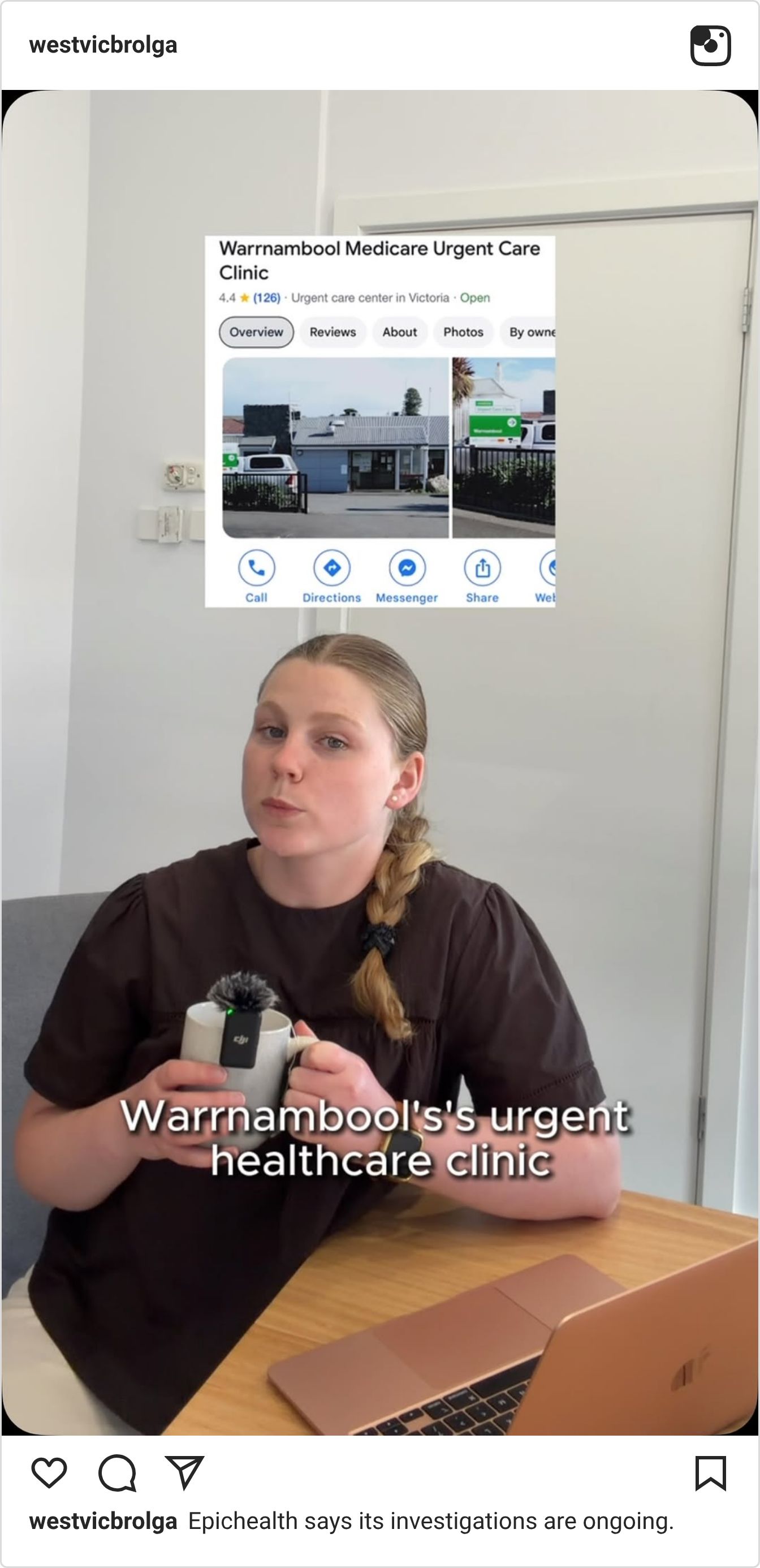
This week, Zara looked into a hacking in Warrnambool.
Check out the video below.
I also had the pleasure of witnessing a unique tradition in Ballarat - the town crier. You can watch more on that story here.
🌏 Across the country 🌏
The national story

Federal Environment Minister Murray Watt has the final say on whether the Hunter Valley Operations coal mine can keep digging until 2045.
Last week, an update from the Environment Protection Agency indicated a decision had been made. But further detail was not provided.

That’s a wrap - thank you for joining us. Z will be back with you early on Friday for another local news round-up.
We hope you enjoyed this issue, and we’d love to hear your thoughts - yell out anytime by replying to this email.
Cheers,
Darcie & The West Vic Brolga team.